Runes · History and Practice
Bindrunes Are Not Arbitrary Symbol Collages
- Author
- Ellie
- Published
- 2025-01-05
Bindrunes need to be read as writing, not as free-form decoration
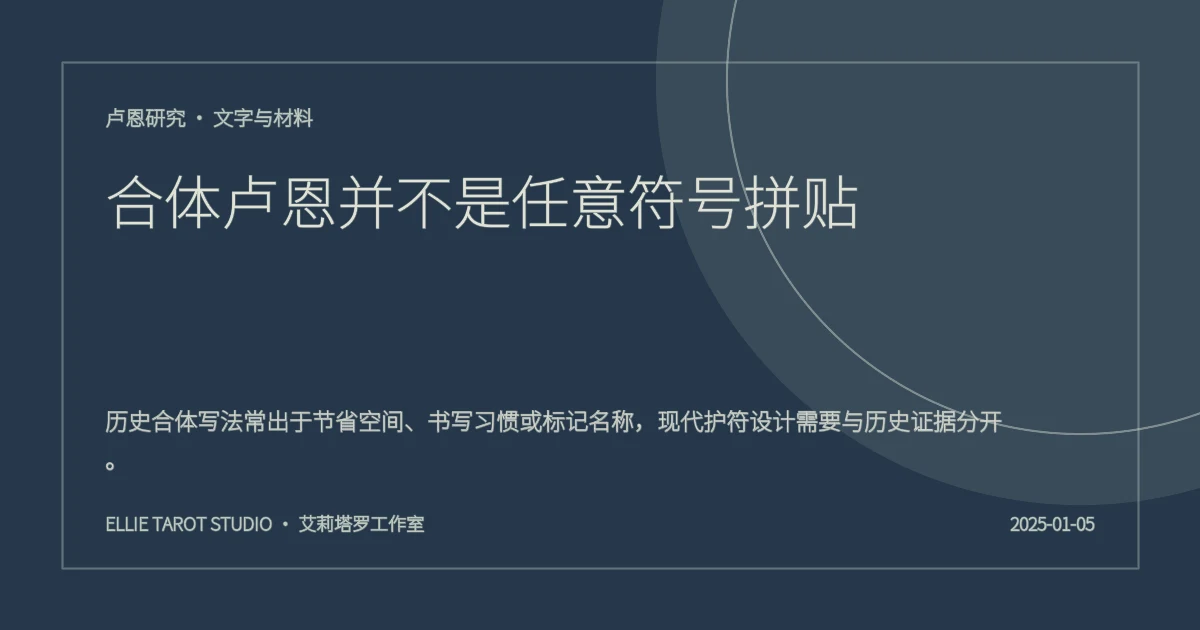
The short answer is this: historical bind-rune forms are not arbitrary symbol collages. In the surviving material, they usually appear because someone needed to save space, follow a local writing habit, or mark a name. That is a very different thing from a modern talisman design. The most reliable way to read them is to keep writing history, inscription evidence, and contemporary practice in separate layers.
I find that separation more useful than any single all-purpose chart, because it stops modern keywords from being projected back onto every old inscription.
What the historical material actually contains
The Danish National Museum describes runes as a Germanic writing method, and the surviving material includes memorial stones, wooden slips, bone objects, metal, and everyday items. That matters, because bind-rune forms are not floating symbols detached from use; they belong to things people wrote on, carried, and handled.
The Swedish Runor database shows a good research habit in practice. It places the inscription number, place, date, material, transcription, and interpretation side by side. That layout quietly reminds the reader that an interpretation is not the same thing as a reading, and that some uncertainty should remain visible.
How to tell different rune systems apart
Before interpreting a bind-rune form, first identify whether the material uses Younger Futhark, Younger Futhark with later forms, or medieval runes. The source material is clear that the same shape can change across periods in sound value, name, and form. So a comparison chart alone is never enough.
A small note-taking method helps here: write down the glyph, the transcription, the language reading, the archaeological context, and any modern association in five separate lines. For example:
- Glyph: the visible rune shape
- Transcription: how the inscription is rendered
- Language reading: what the text likely says
- Context: stone, wood, bone, metal, or object
- Modern association: any present-day symbolic reading
That structure keeps the evidence from being flattened into one undifferentiated “meaning.”
Where modern symbolic reading fits
Modern symbolic reading can exist, but it has to name its own basis. Is it drawn from inscriptions, from rune poems, from a modern author, or from a personal method? Those are not interchangeable sources.
This is especially important with bind-rune design. A modern amulet or graphic can be meaningful as a contemporary practice, but it should not be presented as if it were automatically supported by historical evidence. The historical record can show that runes were used to write language and sometimes to compress or mark names; it does not license every current combination as ancient fact.
Why a single comparison table is not enough
A rune comparison table can be helpful for quick orientation, but it also hides the very things that matter most: date, language, evidence strength, and transmission history. It can make twenty-four characters look like twenty-four fixed personalities, when the source material is actually more fragmentary and more specific than that.
The more careful approach is to treat rune material as broken, partial writing evidence. Some inscriptions are clear. Some allow more than one reading. Some remain uncertain. That uncertainty is not a weakness to be erased; it is part of how the material survives.
When the source, the inference, and the modern use are clearly labeled, bind-runes become easier to check, cite, and compare—and much less likely to turn into unsupported mythology.