
Runes · Elder Futhark
Fehu Rune: Start with Sound Value and Material Evidence
- Author
- Ellie
- Published
- 2025-04-20
Fehu Rune: Start with Sound Value and Material Evidence
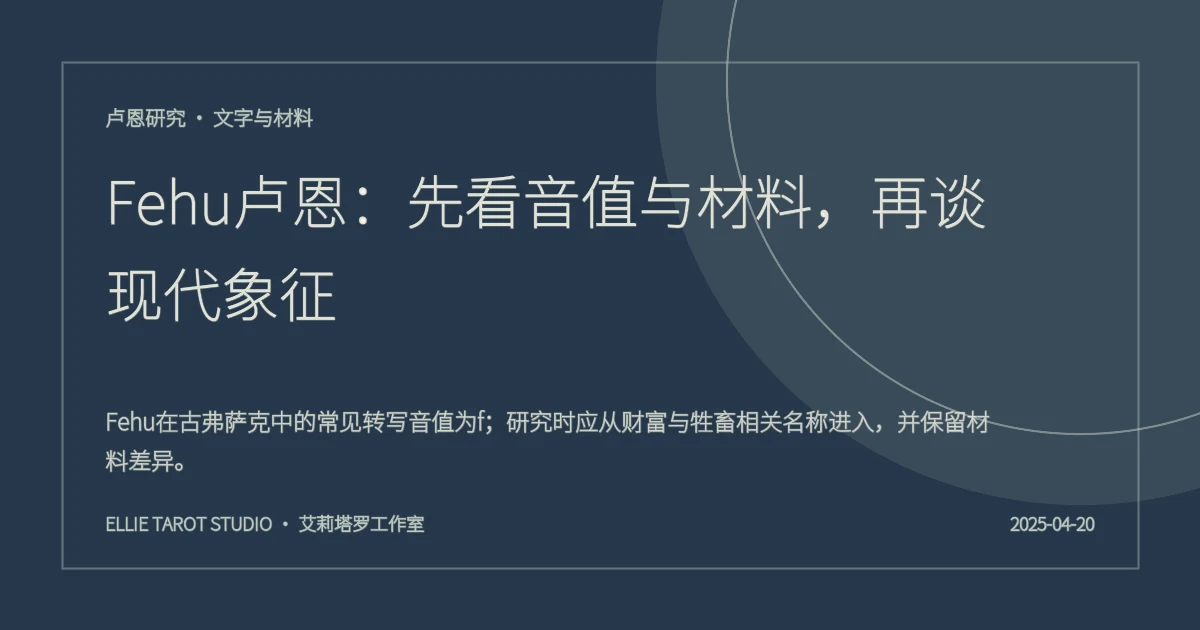
Fehu in the Elder Futhark is commonly transcribed with the sound value f. If you want to read it well, the safest starting point is not a modern keyword list, but the rune’s language function, its name associations with wealth and livestock, and the material it appears on. That order matters because the same sign can shift in sound value, name, and form across periods and contexts.
What Fehu first tells us
The practical point is straightforward: Fehu is not best approached as a fixed “symbol of abundance” before anything else. It is a rune used in writing, so the first question is what language system it belongs to, what sound value it usually carries, and where it sits in the inscription.
For Fehu, the common transliteration value is f. From there, a historically responsible reading can move toward names connected with wealth and cattle/livestock. That connection is useful, but it should stay grounded in the actual inscriptional context rather than being treated as a universal meaning that automatically fits every instance.
I find this sequence more convincing than starting with a general symbolic dictionary, because it keeps the evidence visible before interpretation begins.
Read the inscription before the symbol
The useful historical question is not only “What does Fehu mean?” but also “What kind of object carries it?” The source notes that rune materials include memorial stones, wooden pieces, bone objects, metal, and everyday items. That range already tells us that runes were part of ordinary writing practices, not only later symbolic reading.
A concrete way to take notes is to separate each item into five layers:
- Shape of the rune
- Transliteration or sound value
- Language reading
- Archaeological context
- Modern association
For example, if Fehu appears in an inscription database entry, record the database number, location, date, material, transliteration, and interpretation separately. A small table like that makes it much easier to see where the evidence is firm and where it becomes tentative.
Why material differences matter
The source material emphasizes that runes should be read with attention to material differences. This is not a minor technicality. A rune on stone, wood, bone, metal, or an everyday object does not sit in the same evidential frame. The object type helps shape what kind of reading is plausible.
The Swedish Runor database is described as placing inscription number, location, date, material, transliteration, and transliterated text side by side. That arrangement is worth noticing because it keeps uncertainty in view instead of smoothing everything into a single polished meaning.
So when Fehu is discussed, the question is not just whether “wealth” fits. It is whether that reading fits the inscription’s language, position, and object type, and whether the evidence supports it directly or only loosely.
Where modern symbolism can and cannot begin
Modern symbolic reading is not rejected here, but it needs a clear label. The source explicitly says that modern interpretation may exist, yet it should state whether it is based on inscriptions, rune poems, modern authors, or personal method. That distinction is essential.
A Fehu reading that leans on wealth imagery may be plausible, but it should not be presented as if every historical instance proves the same lesson. The boundary is simple: historical evidence first, modern symbolism second. If that order is reversed, it becomes too easy to project contemporary keywords back onto every older material.
What to keep in view when Fehu appears
Fehu is best handled as a layered piece of evidence: a rune with a common sound value of f, a name associated with wealth and cattle, and a form whose meaning depends on inscriptional setting. That makes it a good example of why rune study benefits from careful separation between writing history, material evidence, and later practice.
If the source is not clear about which layer it belongs to, the reading should stay open. That is not weakness; it is what keeps the interpretation usable.